Tractography Methods
HINEC ships three trackers over one shared nim struct, selected by the
algorithm: key in the config's tractography: section. A second axis, field:,
chooses whether direction information comes from the DTI tensor or from CSD FOD
peaks. This page is the map; each tracker links to its own deep-dive.
runTractography(nim, config)
        │  dispatch on config.tractography.algorithm   (runTractography.m)
        ├── 'standard' → nim_tractography_standard      FACT, discrete voxel tensors
        ├── 'hinec'    → nim_tractography_hinec          interpolated streamlines
        └── 'mmf'      → nim_tractography_mmf_connframe   connection-form Method of Moving Frames
What it produces
Seeding from a region rather than the whole brain gives bundle-specific
tractography. Below, six ISMRM 2015 bundles spanning the major fibre classes,
each seeded from its own mask and filtered by the endpoint pair and containment
corridor that define it — see seeding.roi and
filter.endpoints_in.
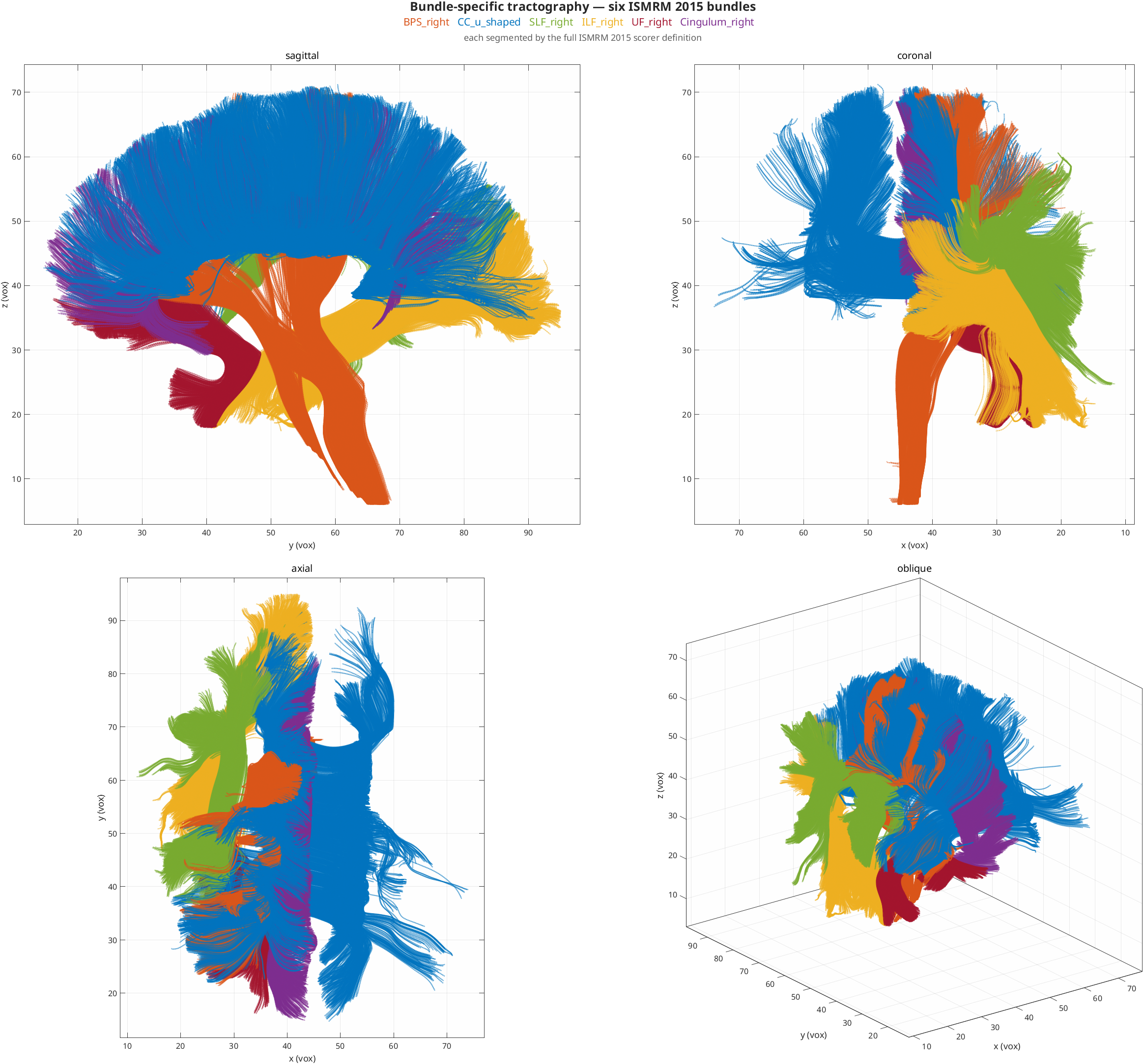
Each is reconstructed independently; they are drawn together here only to show their spatial relationship. Per-bundle comparisons against ground truth are in ISMRM Scoring.
The three trackers
| Algorithm | File | Model | Integration | Interpolation | field |
|---|---|---|---|---|---|
standard |
nim_tractography_standard.m |
single tensor | Euler (FACT) | none (discrete voxel tensor) | dti |
hinec |
nim_tractography_hinec.m |
tensor or CSD FOD | Euler / RK2 / RK4 / RKF45 | trilinear | cubic | spline | dti | csd |
mmf |
nim_tractography_mmf_connframe.m |
tensor or CSD FOD | RK4 or RKF45 on the frame system | connection 1-form field | dti | csd |
template |
nim_tractography_template.m |
single tensor | Euler | trilinear dyadic | dti |
template is not a research method: it is the ≈100-line worked example of the tracker
interface, kept runnable so a new algorithm can be started by copying it. The contract every
tracker follows — what runTractography hands over, what must come back — is in
Writing your own tracker and is logged by every run as
tractography/tracker_input.txt.
standard — FACT
Classic Fiber Assignment by Continuous Tracking. Steps voxel-to-voxel along the discrete principal eigenvector with no sub-voxel interpolation. Fast, simple, the reference baseline. Full internals: Standard Tractography.
hinec — interpolated streamlines
The workhorse interpolated tracker. Tracking is interpolation plus integration only — the direction returned is a pure function of position, so classical Runge–Kutta order theory applies to it.
- Interpolation.
interpolation.methodselects the spatial kernel:trilinear(\(C^0\)),cubic(\(C^1\), Keys cubic convolution — not a spline), orspline(\(C^2\)). The kernel's smoothness caps the order the integrator can actually reach; measured orders are in Solution Verification.interpolation.upsampleresamples the field onto a grid of spacing1/upsamplevoxels before the interpolants are built (>1refines,<1coarsens) without changing the coordinate frame. - Integration.
integrator.method=euler,rk2,rk4(default), orrkf45(Dormand–Prince embedded pair with adaptive stepping;integrator.adaptive,tolerance,step_min,step_max,safety). See RKF45. field: dtiinterpolates the dyadic \( v_1 v_1^{\mathsf T} \) and takes its principal eigenvector, which is sign-invariant — interpolating signed eigenvector components would average across the arbitrary per-voxel sign of a line field.field: csdtracks FOD peaks: at each step the peak nearest the incoming tangent is taken, which reduces a multi-valued field to one direction and resolves crossings by approach direction. Requires the CSD peak field (see below).- ACT (Anatomically Constrained Tractography), off by default (
tractography.act), active only when WM/GM/CSF masks are present in thenim.
sel_power has been removed
Earlier versions re-weighted each stencil voxel by \( |n\cdot v|^{\text{sel\_power}} \),
the alignment of its direction with the incoming tangent. For DTI there is one principal
eigenvector per voxel and so nothing to disambiguate; the term simply bent a
single-valued field toward the current heading, making the ODE direction-dependent
(\( dx/ds = v(x, dx/ds) \)) and putting it outside classical order theory. It is gone
from hinec, and mmf.frame_sel_power — the same mechanism inside the MMF geometry,
weighting each neighbour by \( |n\cdot e_1|^{sel} \) when denoising the tangent field —
has been removed with it. Measured against the curvature of the ISMRM ground-truth
curves, the exponent changed nothing (correlation 0.217–0.239 across sel 0 to 64).
Nearest-peak selection under field: csd is retained because it is structural, not a
tunable steering term.
Renaming (July 2026)
hinec is the tracker previously mislabelled algorithm: mmf with
integrator: rkf45. It has nothing to do with the Method of Moving Frames. The name
mmf now belongs to the genuine connection-form tracker below.
mmf — connection-form Method of Moving Frames
Chun & Peng (in preparation). Builds an orthonormal moving-frame
field {e1, e2, e3} plus its connection 1-form (curvature + torsion) from the
direction field at the start of each run (runTractography step 3), then traces by evolving a carried frame with the connection structure
equation — not by re-sampling a direction field. field: csd builds a per-peak
connection, giving multiple pathways through crossings. Full internals:
MMF Connection-Form Tractography.
The field: axis — DTI vs CSD
Both hinec and mmf accept field: dti (default) or field: csd.
dti— direction(s) from the diffusion-tensor principal eigenvector. One direction per voxel; cannot represent crossings.csd— direction(s) from Constrained Spherical Deconvolution FOD peaks. Up tocsd.max_peaksfiber populations per voxel; resolves crossings.
CSD FOD reconstruction
src/nim_calculation/nim_csd.m — a native single-shell, single-tissue CSD (Tournier 2007):
- real spherical-harmonic fit of the DW signal (design matrix from bvecs,
lmax), - single-fiber response function estimated from high-FA voxels,
- constrained spherical deconvolution (iterative non-negativity),
- peak extraction from the FOD.
It writes peaks into the same interface the multi-direction trackers consume, so CSD and the DTI field are interchangeable upstream of tracking:
nim field |
Meaning |
|---|---|
nim.peaks [X Y Z maxK 3] |
up to maxK unit peak directions per voxel |
nim.npeaks [X Y Z] |
number of valid peaks per voxel |
nim.peak_w [X Y Z maxK] |
peak amplitudes (used by SIFT) |
nim.fod_sh |
SH FOD coefficients |
Provisioning & caching. runTractography provisions the peaks before the algorithm
dispatch, so any tracker running field: csd — hinec and mmf alike — gets them. The FOD
is computed once with nim_csd and cached next to the source nim as <source>_csd_<settings>.mat, named by every CSD
setting (lmax, n_iter, peak_thresh, peak_min_sep, max_peaks), so a run with
different settings never reuses another run's peaks; later runs with the same settings
load the cache. Alternatively tractography.csd.peaks_file supplies an external peak
field on the same grid (see scripts/mrtrix_peaks_to_hinec.py).
CSD parameters (config section tractography.csd):
| Key | Default | Meaning |
|---|---|---|
lmax |
6 | SH order (capped by the number of directions) |
max_peaks |
3 | max peaks kept per voxel |
peak_thresh |
0.5 | min peak amplitude (fraction of max FOD) |
peak_min_sep |
45 | min angular separation between peaks (deg) |
n_iter |
50 | deconvolution iterations |
SIFT — tractogram filtering
src/nim_tractography/nim_sift.m + bin/run_sift.sh. A post-processing filter
(Smith 2013 analog, per-lobe): it prunes streamlines so that streamline density on each FOD
lobe matches that lobe's FOD amplitude. Each streamline segment is attributed to the FOD
peak it best aligns with; lobes carrying more density than their amplitude warrants are
over-represented, and streamlines running through them are removed. This cuts overreach
(false-positive spray) for precision, and — unlike a per-voxel density match — distinguishes
a legitimately dense bundle from invalid spray loading a weak/wrong lobe.
Requires a CSD FOD field (nim.peaks + nim.peak_w). No re-tracking — it filters an
existing run's tractogram into a new scorable run dir:
| Key | Default | Meaning |
|---|---|---|
sift_batch_frac |
0.03 | fraction of streamlines removed per iteration |
sift_n_iter |
60 | max iterations |
sift_min_keep |
0.20 | floor on fraction of streamlines kept |
sift_align_pow |
1 | weight excess by mis-alignment (0 = off) |
Output → hinec_runs/<run>_sift/. With --score, runs the
ISMRM scorer on the filtered result.
PFT — external baseline (DIPY)
Particle Filtering Tractography (Girard 2014) via DIPY was used as an external comparison baseline for the recall and overlap of deterministic tracking. It uses CSD FOD, probabilistic tracking, CMC anatomical priors, and particle-filter backtracking. The experimental comparison script is kept with local research tools and is not part of the supported HINEC commands.
Track data structure
Every tracker returns the same structure: tracks is a cell array; each cell is an N×3
matrix of voxel-space coordinates giving the complete trajectory (not just endpoints);
N varies per fiber. Saved under <run_dir>/tractography/tracks_<algorithm>_<timestamp>.mat
together with options, elapsed_time, algorithm and track_meta (the tracker's meta:
seed_index, seed_points, n_seeds, optional trace). Point order within a track is
[backward half reversed; seed; forward half]. The full contract, including what a tracker
receives, is in Writing your own tracker.
Config-driven experiment workflow
Preprocess once, then iterate tractography without re-preprocessing. This is the sanctioned way to run experiments — do not hand-write MATLAB batch scripts or hand-create run dirs.
1. Preprocess once (main.m writes the canonical nim to the data layer, plus a copy in
the run dir, and reuses an existing preprocessed DWI if present):
./bin/run_hinec.sh data/ismrm2015/ismrm2015 ismrm2015.mat config/ismrm2015.yml
# → data/ismrm2015/ismrm2015.mat  (canonical processed nim)
2. Iterate tractography (auto-sourced from the data-layer nim; each run gets its own tagged, scorable run dir):
# single config
./bin/run_tractography.sh hinec_csd --score

# design-space sweep with --set (DSE), no new YAML per point
for d in 4 8 16; do
  ./bin/run_tractography.sh hinec_csd --score --set seeding.density=$d
done
<config>acceptsconfig/<name>.yml,<name>.yml, or bare<name>.- Source defaults to
data/ismrm2015/ismrm2015.mat; override with--source <nim.mat | run_dir>. The DWI reference is copied (frozen) into the new run'sintermediate/(+SOURCE.txt) so a later reprocess can't corrupt an old run's scoring reference. --set key=valueoverrides any schema parameter on the CLI, addressed by canonical path (tractography.integrator.step), by path with the section assumed (integrator.step), or by a bare leaf name when it is unique (upsample). Unknown or ambiguous keys are an error, not a silent no-op. The run-dir name is tagged with the overrides andoverrides.txtrecords them.--scorerunsbin/run_ismrm_scoring.shon the run dir →scoring/renauld2023/results.json(headline keysmean_f1,mean_OL,mean_OR_gt,VB). Compare runs by that JSON.
Data layer vs run dirs. The nim + preprocessed refs + CSD cache
(data/ismrm2015/ismrm2015_csd_*.mat) live in data/ismrm2015/; hinec_runs/run_*/ hold
tractography outputs only. Never store a nim inside a run dir.
See also Run Directory System and ISMRM Scoring.
Choosing a tracker
| Goal | Start with |
|---|---|
| Fast baseline / sanity check | standard (config/standard_dti.yml) |
| Best deterministic single-tensor result | hinec + field: dti (config/hinec_dti.yml; loosen termination.angle_max / termination.fa_min to push recall) |
| Crossings resolved by FOD | hinec + field: csd (config/hinec_csd.yml) |
| Intrinsic curvature/torsion geometry | mmf (config/mmf_dti.yml / mmf_csd.yml) |
| Cut overreach after tracking | any of the above, then run_sift.sh |
| Probabilistic recall reference | External PFT comparison (research result only) |
YAML Config documents every parameter; it is generated from
src/nim_utils/nim_config_schema.m, the single source of truth for the config surface.
config/README.md lists the shipped presets and the naming rule they follow.